
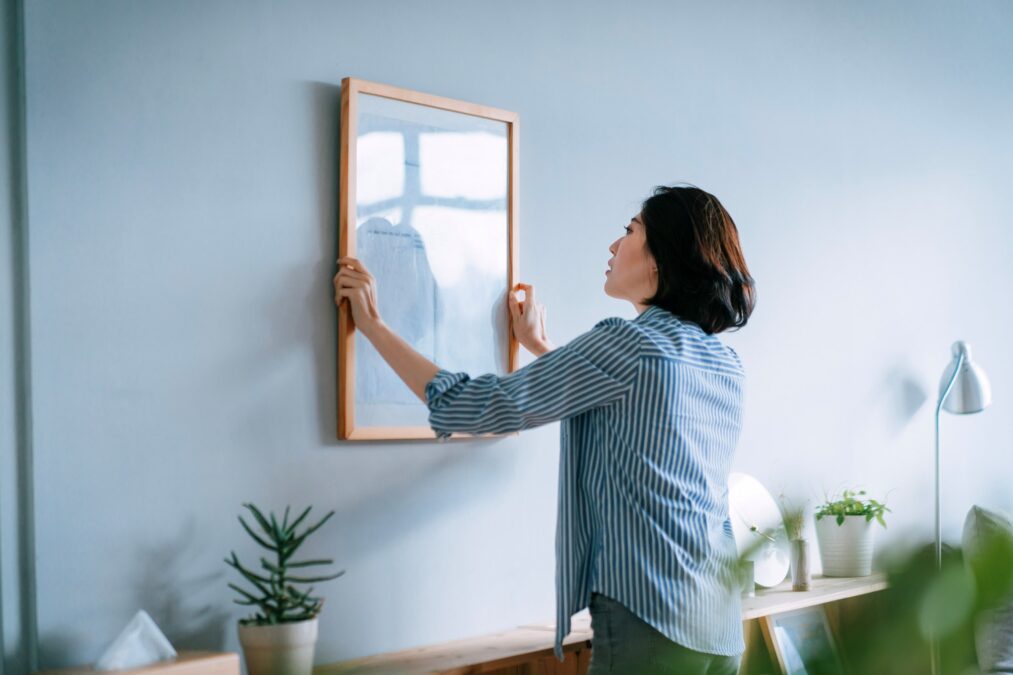
Whether you’re styling a gallery wall or finding the right spot for a single canvas, a few simple principles make all the difference between artwork that feels intentional and elevates your space, and something that looks, quite simply, off.
Here’s a simple guide to measuring and hanging wall art with precision.
Start with the right height
The most common mistake homeowners make is hanging art too high. The standard used by galleries and interior designers is to position the centre of the piece between 57 to 60 inches from the floor, depending on your ceiling height, which is roughly average eye-level for a standing adult.
Measure to the centre of the artwork, not the top of the frame, and once placed, use a level to ensure the piece sits perfectly straight. Even a slight tilt becomes noticeable over time, particularly when viewed against architectural lines like doorframes and windows.
When placing a piece above furniture, like a sofa, console, or headboard, keep the bottom of the frame six to eight inches above the furniture below. This helps maintain a visual connection between the art and the piece beneath it, rather than allowing it to feel like it’s floating. In dining rooms or reading nooks where you spend most of your time seated, hanging art slightly lower – with the centre around 54 to 57 inches from the floor – creates a more natural and comfortable sightline.
Sizing art for the space
Scale matters as much as height and alignment. A small piece on a large wall tends to look lost, while an oversized canvas in a tight hallway can feel overwhelming. A good rule of thumb is that art should cover roughly two-thirds of the wall or the furniture it sits above. If you have a smaller piece, grouping it with others can solve the scale problem beautifully.
For gallery walls, treat the entire arrangement as a single piece of art, anchoring its centre at eye level, and keep spacing between frames consistent at three to six inches. Lay your arrangement out on the floor first before committing to any holes in the wall.
Know your wall type before you pick up a drill
Most modern homes in Canada have drywall, where a standard picture hook is usually strong enough for lighter pieces. Heavier artwork may need additional support, like securing the hardware into a stud, to keep it securely in place.
Older homes often have plaster-and-lath walls, which require more care. Plaster is brittle and can crack if handled the same way as drywall. Pre-drilling a small pilot hole and placing a piece of painter’s tape over the drilling spot can help minimize surface damage before installing a reinforced wall anchor designed for heavier items.
For concrete or brick walls, you may need a heavy-duty drill and specialized wall fasteners (or call in a professional). Adhesive hanging strips are a practical alternative for lighter pieces and an excellent option for renters who want to avoid putting holes in the wall entirely.
Protect your art from light damage
UV rays from direct sunlight will gradually fade pigments and cause irreversible damage to paper, canvas, and photographs. Keep pieces out of direct sunlight and away from windows that receive strong afternoon light.
Standard window glass blocks only about 40% to 50% of UV radiation. If you have a piece you love in a bright room, ask your local framer about conservation-grade UV glass or acrylic, which can block up to 99% of rays.
If you’d like to spotlight your favourite pieces, LED lighting is your best bet, as it emits very little heat and minimal UV radiation compared to halogen or older incandescent bulbs.
Think about visual weight, not just physical size
A detail rarely discussed when it comes to art: dark, heavy frames need more breathing room than the physical dimensions suggest. A large black frame can visually dominate a wall, even when surrounded by what appears to be sufficient space. A light natural wood frame in the same size, on the other hand, reads as much quieter. When planning a grouping, take note of the visual “heaviness” of each piece and balance accordingly – that’s what separates a gallery wall that feels curated from one that feels crowded.
The art you choose to display is a reflection of your personality and the life lived within your four walls. While the measurements and levels provide the framework, the goal is to create a home that feels uniquely yours. By applying these few simple principles, you can hang your favourite pieces with confidence, where your most cherished memories and milestones are beautifully on display.