
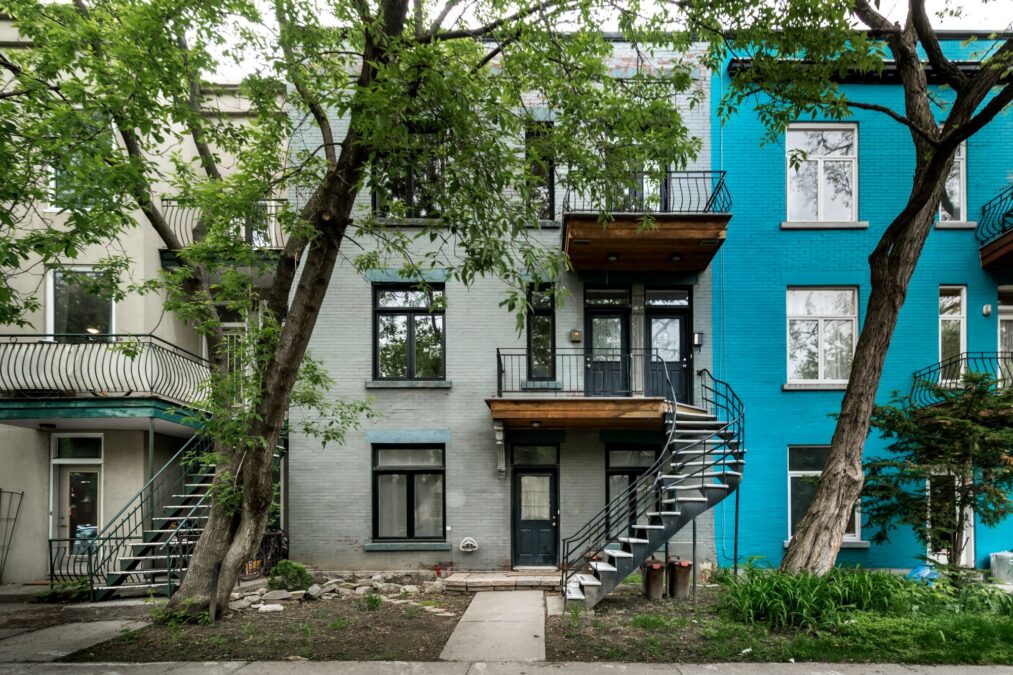
Buying a plex (a duplex, triplex, or fourplex) as a first property is becoming an increasingly popular strategy for first-time buyers, especially in expensive markets like Montreal and its surrounding area. The concept is straightforward: live in one unit and rent out the others to help pay the mortgage. Here’s what first-time buyers need to know about buying this property type.
Why Consider a Plex?
Purchasing a plex is an excellent entry point into real estate investing. By living on-site, you can easily communicate with tenants and handle maintenance without the headaches of remote property management. The financial advantages are immediate: rental income from your secondary units covers a significant portion, sometimes even the entirety, of your monthly mortgage payment, accelerating your equity growth.
Down Payment Rules in Quebec
One of the biggest advantages of buying a plex as an owner-occupant is the lower down payment requirement compared to traditional investment properties. Investment properties require a minimum 20% down payment. In contrast, owner-occupied properties can take advantage of insured mortgage rates: just 5% down on the first $500,000 and 10% on the remainder for a duplex, or 10% down for triplexes and fourplexes.
Rental Income Boosts Borrowing Capacity
The good news is that rental income boosts borrowing capacity. Most lenders add 50% of the gross rental income to personal income when calculating loan eligibility, which often makes it possible to purchase a higher-value property.
If you plan to obtain mortgage loan insurance through the CMHC Income Property program, t investors must meet specific credit score benchmarks alongside strict down payment verifications. Lenders will thoroughly review the origin of your funds over a set period, requiring documented proof of assets like personal savings, familial gifts, or equity from a previous property sale.
Closing Costs to Budget For
Beyond the down payment, up to 3% of the purchase price should be set aside for closing costs.
In Quebec, borrowers who obtain mortgage loan insurance must also pay Quebec Sales Tax (QST) on the total insurance premium. Unlike insurance costs, which are paid along with the monthly mortgage payment, the QST amount cannot be rolled into the mortgage – it’s typically paid upfront at closing.
Notary fees typically range from $1,800 to $2,800, and are often higher for a plex than for a single-family home due to the added complexity of the transaction. The welcome tax (land transfer tax) is also owed to the municipality a few weeks after closing, with the amount varying by property value and municipality.
Regular Expenses to Anticipate
New plex owners often underestimate the true cost of ownership. Municipal and school taxes are generally higher for a plex than for a single-family home of similar value. Insurance is pricier too, since an owner-occupied landlord policy tends to cost more than standard homeowner coverage.
For maintenance and repairs, 1% to 2% of the property’s value should be budgeted annually, keeping in mind that older buildings cost more. Even with full occupancy, setting aside at least one month’s rent per unit per year to cover potential vacancy is recommended.
Becoming a Landlord in Quebec
While living in your own plex simplifies property oversight, it also blurs the line between your personal life and your role as a landlord. Tenant selection becomes deeply personal when a problematic renter lives just one floor away. To protect your daily peace of mind, it is essential to rigorously verify references, credit scores, and rental histories before signing any lease.
Beyond day-to-day management, you must navigate a strict legal landscape. Landlord-tenant relations in Quebec are governed by the Tribunal administratif du logement (TAL). Under TAL regulations, rent can only be set freely when a unit is vacant or during a new lease transfer; once a tenant is in place, annual rent increases are strictly regulated. Owners also bear the full legal and financial responsibility for keeping the building in habitable condition, meaning major repairs to the roof, plumbing, or foundation fall squarely on your shoulders.
Before You Make an Offer
Buying a plex as a first home can be a financially smart move, but it’s far from a passive investment. Owner-occupants become investors and property managers simultaneously. If the thought of responding to a late-night call about a leaking faucet or heating issue feels overwhelming, it is important to carefully weigh both the financial advantages and lifestyle trade-offs before making the leap.
Running the numbers with realistic figures, consulting a mortgage broker experienced with multi-unit properties, and talking to plex owners provides invaluable insight. Real-world experience from seasoned investors is just as important as the financial calculations themselves.