
Bank of Canada keeps overnight rate at 2.25% as economy stagnates
For the fifth consecutive announcement, Canada’s central bank leaves the key lending rate untouched
June 10, 2026
6 min. read
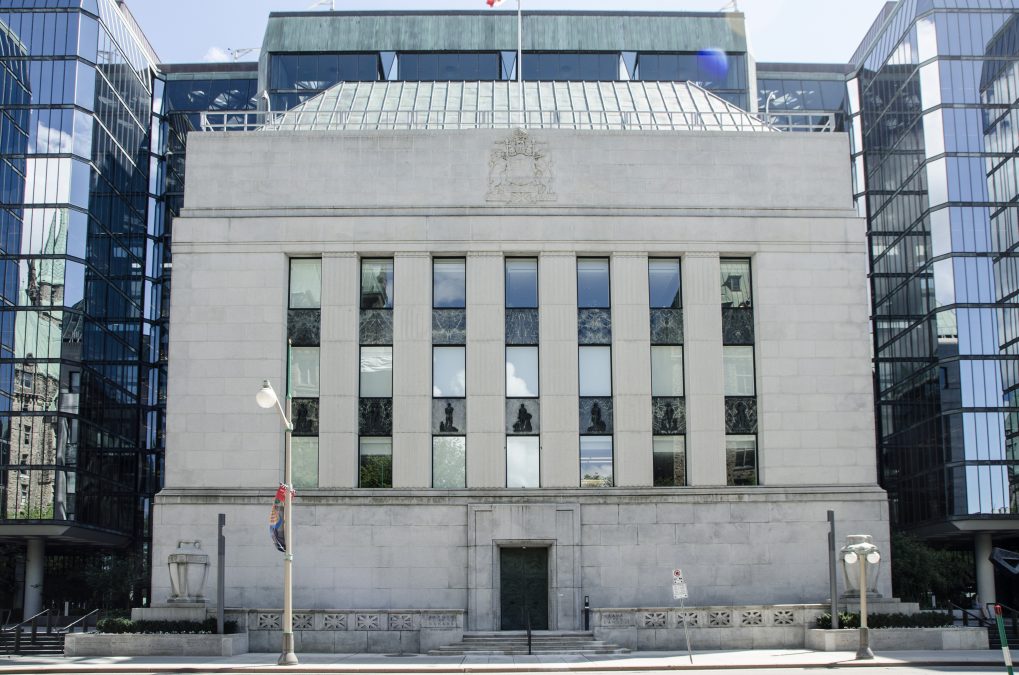
In its fourth scheduled announcement of 2026, the Bank of Canada held the target for the overnight lending rate at 2.25%. This marks the fifth consecutive hold to interest rates since October of last year.
As the conflict in the Middle East continues, elevated energy prices and ongoing supply chain pressures are contributing to higher inflation, even as Canada’s economy remains soft. While employment levels have remained relatively stable, economic growth has weakened and uncertainty surrounding United States trade policy persists, factors that influenced the Bank’s decision to keep the key lending rate at its current level this month.
“Since our April decision, the economic impact of the ongoing conflict in the Middle East has increased. Higher energy prices and disruptions in global supply chains are weighing on global growth and pushing up inflation. At the same time, the US administration continues to propose new tariffs and trade policy uncertainty remains elevated,” said Tiff Macklem, Governor of the Bank of Canada, in a press conference with reporters following the announcement. “Against this backdrop, the Canadian economy has remained soft and inflation has increased. Monetary policy continues to be focused on ensuring higher energy prices do not turn into persistent inflation, while helping the economy adjust to headwinds. We are committed to keeping inflation low and stable over time.
“Economic weakness combined with rising inflation is a dilemma for monetary policy. Raising rates to dampen inflation could further slow the economy. Easing rates to support growth increases the risk that higher inflation becomes persistent. For now, holding the policy rate unchanged balances those risks.”
Canada’s economy is caught between competing pressures. Statistics Canada reported that GDP contracted 0.1% on an annualized basis in Q1 2026, confirming a technical recession. At the same time, inflation has edged higher; the Consumer Price Index (CPI) rose 2.8% year over year in April, up from 2.4% in March, driven largely by higher gasoline prices. That increase reflects both ongoing geopolitical tensions and a base effect from April 2025, when the removal of the federal consumer carbon levy had temporarily suppressed fuel costs. Meanwhile, the labour market has shown some resilience, with the unemployment rate dipping to 6.6% in May.
Stable borrowing costs underpin gradual market recovery
With the overnight rate holding steady, buyers entering the market can do so with a clearer sense of what borrowing will cost them. Variable mortgage rates will remain predictable in the near term, removing one layer of uncertainty from the purchase decision. For those who have been waiting on the sidelines, that stability – even in the absence of a rate cut – may be enough to prompt a move.
“The Bank of Canada finds itself balancing conflicting economic signals. On one hand, May’s employment report delivered a surprisingly strong 156,000 new full-time jobs. On the other, Canada has now entered a technical recession following two consecutive quarters of economic contraction. Add to that the uncertainty surrounding the ongoing CUSMA review, which continues to weigh on consumer and business confidence, and the Bank’s decision to hold rates becomes easier to understand,” said Phil Soper, president and CEO, Royal LePage®.
“There is a silver lining in the current state of Canada’s housing market. Stable borrowing costs are helping to restore buyer confidence, and we are beginning to see sales momentum build in many regions across the country. Provided the broader economic environment does not deteriorate further, we expect the recovery to strengthen through the second half of the year.”
According to the Royal LePage House Price Survey and Market Forecast, the aggregate1 price of a home in Canada decreased 2.0% year over year to $812,900 in the first quarter of 2026. On a quarter-over-quarter basis, however, the national aggregate home price remained relatively flat, increasing just 0.7%.
The Bank of Canada will make its next interest rate announcement on July 15th, 2026.
Read the full June 10th report here. Want to know more about how the overnight lending rate works? Read our explainer on how the Bank of Canada uses this financial tool.
1Aggregate prices are calculated using a weighted average of the median values of all housing types collected. Data is provided by RPS Real Property Solutions and includes both resale and new build.