If you have spent time searching for properties in Quebec, particularly in Montreal, you may have come across listings for condos described as “indivise.” While they can look much like divided condos and may be listed at a different price point, the ownership structure is quite different. These differences can affect financing, how the property is managed and your options as an owner, making it important to understand how indivise ownership works before making an offer.
Two types of co-ownership in Quebec
Quebec recognizes two distinct forms of co-ownership under the Civil Code.
Copropriété divise, or divided co-ownership, is the structure most commonly associated with condos. Each unit has its own cadastral lot number, its own title, and its own legal existence. Owners hold title to their specific unit and share ownership of the common portions proportionally. The building is administered by a syndicate of co-owners. Financing is conventional, and buyers can shop among lenders.
Copropriété indivise, or undivided co-ownership, works differently. The property is registered under a single cadastral number, meaning individual units do not have separate legal titles.Instead, you hold an undivided percentage of the whole building alongside the other owners. For example, in a three-unit building, you might own a 33% share of the property rather than holding title specifically to one unit.
This distinction has consequences that ripple through every aspect of the purchase.
Financing has different requirements
The most significant practical difference between indivise and divise for most buyers is how banks treat the purchase.
Because there is no individual title for the unit, financing an indivise property can involve different requirements and may be available through a more limited range of lenders.. For example, buyers usually need a minimum down payment of 20%, as CMHC mortgage loan insurance, which allows buyers of divided condos and houses to purchase with as little as 5% down, is not available for indivise properties. As a result, buyers need to come to the table with more capital, which can impact affordability and cash flow planning.
There is also a constraint that surprises many first-time indivise buyers: in practice, all co-owners in an indivise building often need to hold their mortgages with the same financial institution. Since the property has a single title, lenders want to ensure there is no conflict between mortgages registered by different banks. This can limit your ability to shop for the most competitive rate at renewal.
The convention d’indivision governs the building
Where a divided condo has a legally mandated declaration of co-ownership and a syndicate structure, an indivise property is governed by a convention d’indivision, a co-ownership agreement drawn up by the owners and notarized. The convention establishes each owner’s percentage share of the property, which unit each occupant has the exclusive right to use, how shared expenses are split, how decisions are made, and what happens if one owner wants to sell.
The convention d’indivision is not required by law, but it is an important document to have in place when purchasing an indivise property.. Without one, the rights and obligations of each owner are governed by the general provisions of the Civil Code, which may not address the day-to-day realities of how the building is run.
The quality and comprehensiveness of the convention d’indivision should be treated as a primary due diligence item. Have your notary review it before signing anything.
All owners are jointly responsible
In an indivise property, the co-owners are jointly and solidarily responsible for shared expenses and obligations. This means that if one owner fails to pay their portion of property taxes, insurance, or maintenance costs, the other owners are legally on the hook for the shortfall.
This shared financial responsibility requires a higher degree of trust and communication among co-owners than a conventional condo purchase, where individual owners’ obligations are more clearly separated.
Why indivise properties exist and why they are common in Quebec
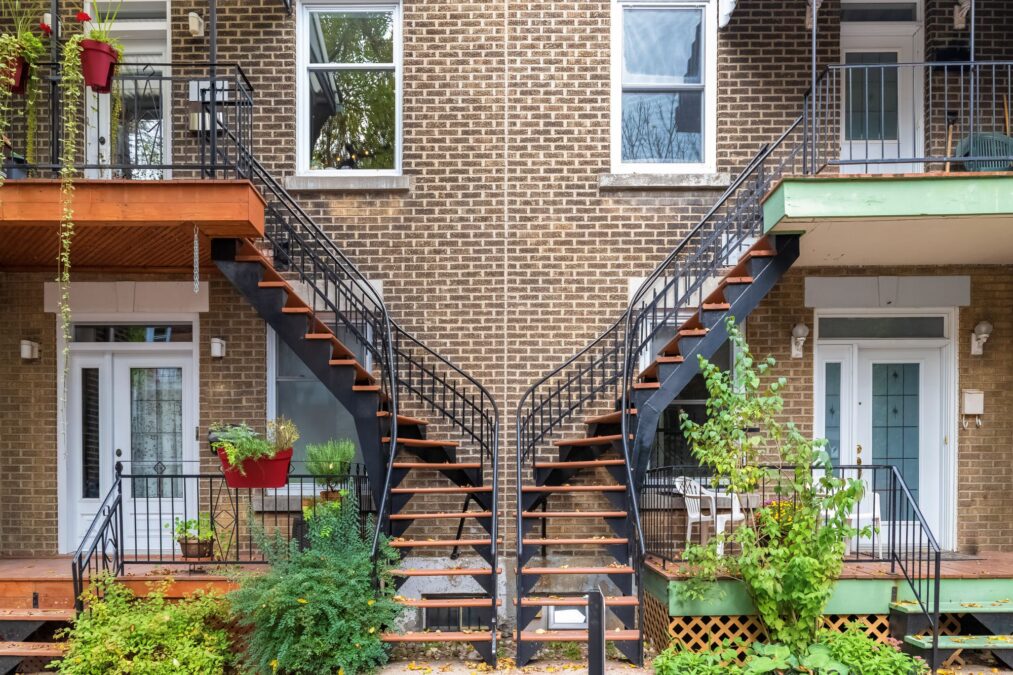
Indivise co-ownership is particularly common in Quebec because of the province’s large stock of duplexes, triplexes, and quadruplexes. Many of these buildings were never converted into divided condos for legal or administrative reasons, or because the owners chose not to incur the costs and complexity of conversion. When one unit in a plex comes up for sale, the buyer acquires an undivided share rather than a titled unit.
For buyers, this can mean access to properties in desirable neighbourhoods at prices below comparable divided condos, because the financing constraints and governance complexity create a smaller pool of eligible buyers. But the lower entry price comes with trade-offs that need to be understood clearly.
What to think about before buying indivise
There are several questions worth working through before committing to an indivise purchase.
- Is the convention d’indivision in place, and is it current? A well-drafted convention covers decision-making procedures, expense allocation, and the process for sale or dissolution of the co-ownership.
- How many co-owners are there, and what is your relationship with them? In a building with two or three units, you will interact with your co-owners on a regular basis. The quality of that relationship matters in a way that it does not in a large divided condo building.
- What is the financial situation of the other co-owners? Because you are jointly responsible for shared obligations, the financial circumstances of one co-owner can potentially create liability for the rest. While information about individual finances may not be readily available, a notary can help you understand the shared obligations and potential implications before you purchase.
- What is your exit strategy? Selling an indivise unit is generally more complex and takes longer than selling a divided condo. The pool of eligible buyers is smaller due to financing constraints, and the other co-owners may have right of first refusal under the convention.
Frequently asked questions
Is buying indivise right for me? Indivise co-ownership suits some buyers well, particularly those buying in a plex with a trusted partner, family member, or in a building with a well-structured convention d’indivision and stable co-owners. The key is going in with full information and having everything documented properly by a notary.
Can I convert an indivise property to divise? In some cases, yes. Converting to divided co-ownership requires the agreement of all co-owners, a surveyor to create individual cadastral lots, and registration of a declaration of co-ownership. It also involves costs and municipal requirements that vary by location. Your notary can advise on whether conversion is feasible for a specific property.
What is the right of first refusal in an indivise property? Under both the Civil Code and most conventions d’indivision, co-owners may have a droit de préemption, the right to purchase your share before you sell it to an outside party. This means that when you decide to sell, you typically must first offer your share to the existing co-owners at the same price and conditions you have negotiated with a potential outside buyer. The timelines and procedures for this process should be clearly set out in the convention.
Can I rent out my unit in an indivise building? This depends on the terms of the convention d’indivision. Some agreements restrict or prohibit renting, since the presence of a tenant can complicate the relationship between co-owners and affect the building’s financing status. Read the convention carefully before assuming rental is permitted.
Do I need a notary to buy indivise? Yes. All real estate transactions in Quebec are completed before a notary. For indivise purchases specifically, the notary’s role is particularly important: they will review the convention d’indivision, verify the title, confirm the terms of the hypothec, and ensure that the structure of the purchase protects your interests.