
Overnight lending rate remains at 2.25% following Bank of Canada’s first decision of 2026
Second straight hold keeps borrowing costs unchanged for Canadians
January 28, 2026
5 min. read
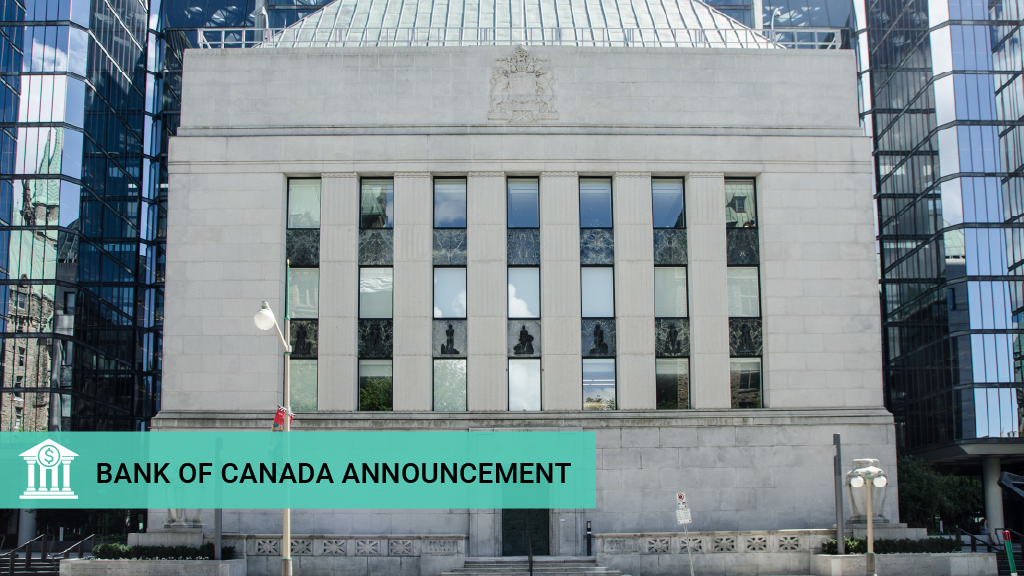
Today, in its first announcement of 2026, the Bank of Canada opted to hold the target for the overnight lending rate at 2.25%. This marks the second consecutive hold to interest rates.
Ongoing United States trade restrictions and geopolitical uncertainty continue to weigh on Canada’s economic growth and dampen consumer confidence. At the same time, inflation has remained relatively stable, giving the Bank of Canada room to maintain its current policy stance. Holding interest rates steady reflects a cautious approach as the Canadian economy adjusts to evolving economic conditions, balancing the need to support growth while keeping inflation firmly under control.
“The Canadian economy is adjusting to the structural headwinds of US protectionism. Businesses are reconfiguring supply chains and investing in new markets. We also expect to see some reallocation of capital and workers as new opportunities open up. This restructuring, including more diversified trade and a more integrated internal market, will support some recovery in our productive capacity. But it will all take some time,” said Tiff Macklem, Governor of the Bank of Canada, in a press conference with reporters following the announcement.
“Monetary policy cannot compensate for the structural damage caused by tariffs, and it cannot target hard-hit sectors of the economy. But it can play a supporting role, helping the economy through this period of structural change, while maintaining inflation close to the 2% target.”
Canada’s Consumer Price Index (CPI) rose 2.4% year over year in December, up from 2.2% in November, largely due to the federal government’s GST/HST holiday tax break that ran from December 2024 through February 2025, a temporary factor that distorted year-over-year comparisons. Meanwhile, the unemployment rate held steady in December, following three consecutive months of employment gains in September, October and November.
Rates hold steady as consumers prepare for spring market
As 2025 came to a close, Canada’s central bank signalled a shift toward supporting economic growth, with inflation now within its desired neutral range. With the next rate decision set for March, just ahead of the spring housing market, consumers are likely to see borrowing costs remain stable.
“Borrowing rates have moved back toward a more neutral setting – neither stimulating nor acting as a drag on economic activity. That’s a return to more normal conditions. Rates can still move modestly in either direction depending on how the economy evolves, but the most likely scenario is a period of stability,” said Phil Soper, president and CEO of Royal LePage®. “For homebuyers and those approaching a mortgage renewal, stability matters. It provides greater certainty around financing costs and allows households to make housing decisions based on need and affordability, rather than trying to time interest rate moves.”
According to the Royal LePage House Price Survey and Market Forecast, the aggregate1 price of a home in Canada decreased 1.5% year over year to $807,200 in the fourth quarter of 2025. On a quarter-over-quarter basis, the national aggregate home price posted a similar decline of 1.1%, reflecting softer market conditions and persistent buyer caution that weighed on activity during the traditionally active fall season.
The Bank of Canada will make its next interest rate announcement on March 18th, 2026.
Read the full January 28th report here. Want to know more about how the overnight lending rate works? Read our explainer on how the Bank of Canada uses this financial tool.
1Aggregate prices are calculated using a weighted average of the median values of all housing types collected. Data is provided by RPS Real Property Solutions and includes both resale and new build.