Bank of Canada maintains overnight lending rate at 2.25% in last announcement of 2025
The Bank made a total four cuts to interest rates in 2025
December 10, 2025
5 min. read
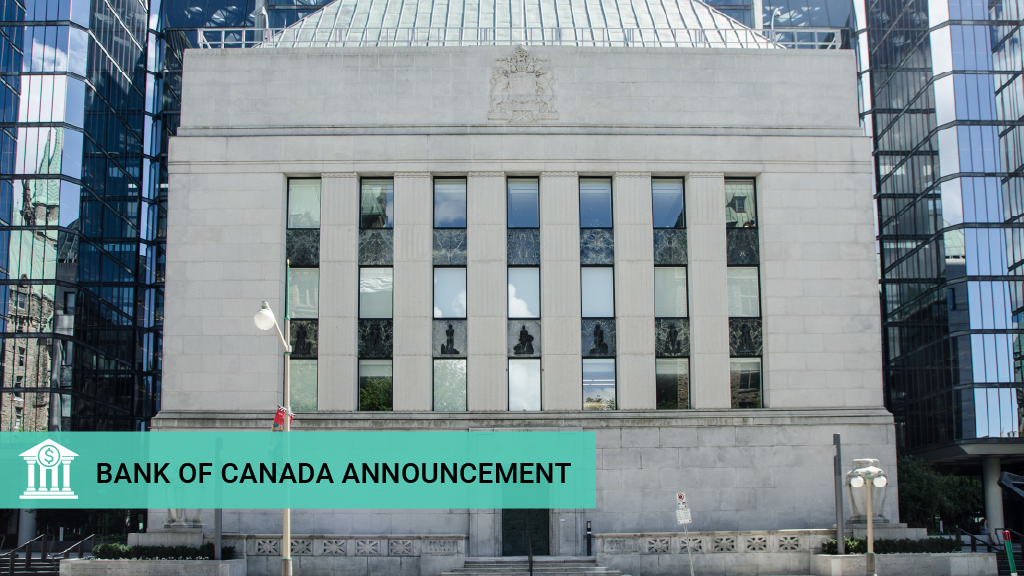
Today, in its final announcement for 2025, the Bank of Canada opted to hold its target for the overnight lending rate at 2.25%. Across the year, the Bank cut its key lending rate a total of four times, dropping it 100 basis points from 3.25%.
Canada’s economy posted a stronger-than-expected 2.6% gain in the third quarter, even as final domestic demand remained flat. At the same time, the labour market is showing early signs of improvement, with solid employment gains over the past three months and the unemployment rate edging down to 6.5% in November, trends that supported the Bank’s decision to hold the overnight lending rate steady.
“While information since the last decision has affected the near-term dynamics of GDP growth, it has not changed our view that GDP will expand at a moderate pace in 2026 and inflation will remain close to target. Governing Council therefore decided to hold the policy rate unchanged. We agreed that a policy rate at the lower end of the neutral range was appropriate to provide some support for the economy as it works through this structural transition while keeping inflationary pressures contained,” said Tiff Macklem, Governor of the Bank of Canada, in a press conference with reporters following the announcement.
“Increased trade friction with the United States means our economy works less efficiently, with higher costs and less income. This is more than a cyclical downturn—it’s a structural transition. Monetary policy cannot restore lost supply. But it can help the economy adjust as long as inflation is well controlled,” he added.
In October, Canada’s Consumer Price Index (CPI) recorded a 2.2% increase compared to the same month last year, down from the 2.4% rise recorded in September. Slower growth in grocery prices contributed to the deceleration in inflation, in addition to falling gasoline prices. Together, these trends signal a gradual cooling in price growth as the broader economy
Latest rate hold brings a measure of stability
After an 18-month rate-cutting cycle, Canada’s central bank is turning its attention to supporting a slowing economy while keeping inflation on a sustainable path. For consumers, this shift brings greater predictability in borrowing costs, a dynamic that could encourage more buyers to step back into the market in 2026.
According to the Royal LePage Market Survey Forecast, Canada’s residential real estate market is expected to post modest price gains next year and an increase in sales activity, as buyers continue to move off the sidelines. The aggregate1 price of a home in Canada is set to remain relatively flat, increasing a modest 1.0% year over year to $823,016 in the fourth quarter of 2026.
“Mortgage rates are no longer the villain in this story. Borrowing costs have stabilized at a level that supports healthy market activity. Buyers can move forward without worrying they are missing out on cheaper money tomorrow. That clarity alone will unlock demand,” said Phil Soper, president and CEO, Royal LePage.
According to a recent Royal LePage survey,2 conducted by Burson, 28% of Canadians who currently rent say that, before signing or renewing their current lease, they considered buying a property rather than renting. When asked what factors influenced their decision to rent instead, 40% of respondents said they were waiting for property prices to decline, and 29% were waiting for interest rates to decrease further. Respondents could select more than one answer.
The Bank of Canada will make its next and first interest rate announcement for 2026 on January 28th.
Read the full December 10th report here. Want to know more about how the overnight lending rate works? Read our explainer on how the Bank of Canada uses this financial tool.
1Royal LePage’s aggregate prices are calculated using a weighted average of the median values of all housing types collected.
2Despite falling prices and lower interest rates, many renters are still pressing pause on home ownership, June 19, 2025